This is my guide to
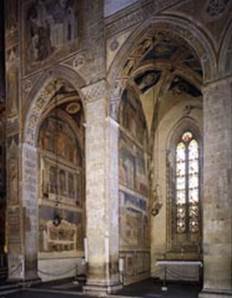
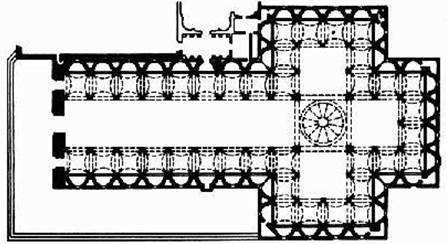
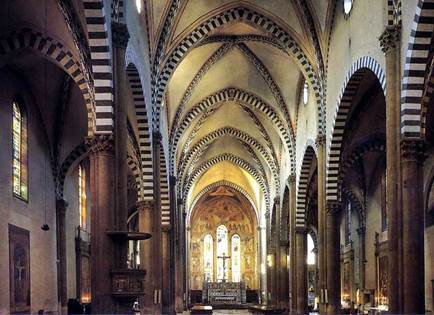
Santa Maria Novella {Mon-Thursday, 9:30-4:30; Fri 1-4:30}- A Dominican
church (therefore
very large, to meet preaching needs),
begun in 1246 (façade is the 1470 work of Alberti). This is the first Italian Gothic
The Italian Gothic style has certain connections to
the northern Gothic of France (which
physically entered
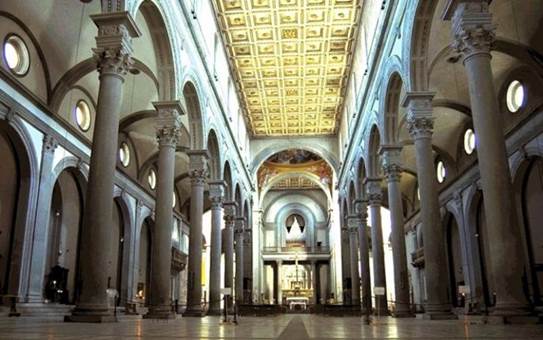
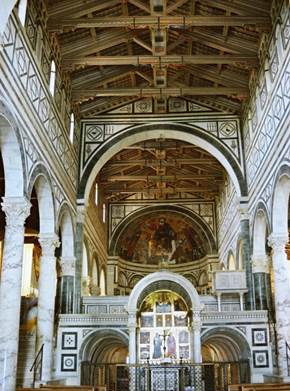
Interior: Italian
Gothic - a great, formative example of this style: check out the feel of the
space. Also note the use of dark gray
stone (pietra serena) against white plaster walls –very Florentine.
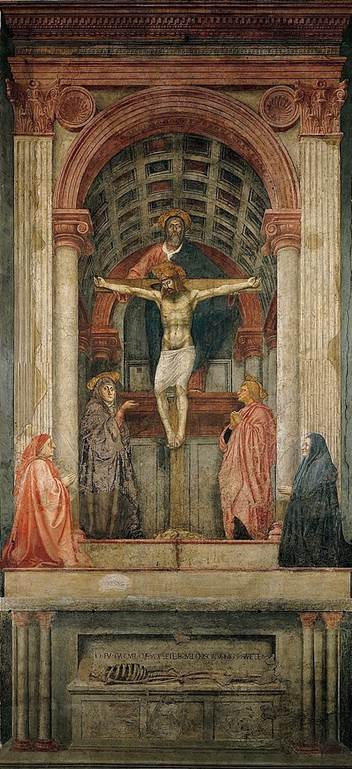
Holy
Trinity: 1425 (way out of chronological
sequence here: this is one of the
pivotal works of the Italian Renaissance, although it is in a church that was
the first fully-developed Italian Gothic building.) Fresco by Masaccio,
on left side of nave, in the middle. Note the classical architectural space he
created for the scene (so markedly different from the space of the church it is
in) and the general classicism of the references, the accurate use of linear
perspective, the statuesque and sculptural nature of the human forms, the
emotion. A work of major
importance, here.
[Crucifix: Supposedly by
Giotto; in the La Sagrestia, off the left transept.]
[Cappella Filippo Strozzi: some frescoes by Filippino Lippi (who is
good, but not nearly as good as his father, Filippo Lippi –you have to look
carefully at some of these names!), at right front of the church.]
Chiostro Verde (“Green Cloister”): {Mon-Sat, 9-4:30; alas, the cloister seems no
longer to be open on Sundays} Entrance
to left of the front of the church itself; separate admission fee. Contains a fabulous cycle of frescoes
by Uccello. Many of the frescoes
are in poor condition; but the magnificent
“Flood” fresco is largely intact and gives some sense of the genius of
the artist. I’m interested if any of my
readers know of any other work any where nearly this old that powerfully and
realistically contains a direct representation of weather, as this works so
successfully does.
Il Duomo - Santa Maria del Fiore - begun in 1294 (much of
design by Arnolfo di Cambio) - the heart of the city
Exterior: late (19th
Century), but still an example of the Florentine love for pattern and, in
particular, for the patterned use of different colored marble –although this
example is pretty gaudy.
[Porta
della Mirandola, sculptural entry on N exterior wall: a very interesting project
containing works by all sorts of people, including Donatello, but confusing
without a plan]
Interior: Example of
Italian Gothic style –again, get the feel of it: it helps to then understand what is going on
in the changes that occur with Brunelleschi.
Worth noting: on entrance wall –3
stained glass windows by Ghiberti, and a big clock, the hands of which move
backwards.
Dome by Brunelleschi -1420-36 [One can climb up into the
structure of the dome, which ought to be interesting and provide spectacular
views of the city, but I never have done it. *XX*] Beautiful
proportions, although more Gothic in design than he would have done had he not
been constrained by the pre-existing structure and underlying shape; and an
engineering marvel. The problem was that the
Florentines had constructed so big a cathedral (this has directly to do
with penis size and competition with the surrounding penises of Sienna and
Il Campanile (The
Exterior: much better
example of Italian Gothic –still pretty over the top, but much more
beautiful. Note where the statuary is
placed, high up on the façade; but don’t waste time looking too carefully, as
they are only copies. (All of these very
important works are actually in the Museo dell’ Opera del Duomo, q.v.,
below.)
[You can climb up inside for
the view, but I never have. *XX*]
Il Battistero (The Baptistery - 5th century, although
the Florentines of the Renaissance mistakenly thought it was a building from
classical antiquity)
Exterior: good example
of Italian Romanesque (only better one in Florence is San Miniato al Monte, q.v.,
below): more horizontal and squat, with the exterior shaped by the form of the
interior space [not unlike the Romanesque in northern Europe], but with a
characteristic, Florentine, patterned use of colored marble –done in a lovely, far
less gaudy way, however.
Bronze
doors: (It is not clear that any of the three
sets of doors are in fact real; I have
never been able to get a satisfactory answer to this question. The east doors, Ghiberti’s “Gates of
Paradise,” most certainly are only copies; the real ones are in
the Museo dell’ Opera del Duomo. As for
the rest, there is no other place to see the real ones, even if these are only
copies; so it’s worth a look here.)
[-South
doors: By Andrea Pisano, done in
1330. Basically International Gothic in
style, but with some marked influence of Giotto. Upper 20 panels are of the life of John the
Baptist; the lower 8 representing the virtues.]
-North
doors: (also the entrance to Il Battistero *XX*) Done between
1403 -24, these represent the project Ghiberti won the right to do in the
competition of 1401 (his entry in the competition –better than any he did for
the actual doors– is in Il Bargello (q.v., below), along with that of
the runner up, Brunelleschi.) The upper
20 panels depict New Testament scenes; the lower 8 the 4 Evangelists and 4
doctors of the Church. (For stylistic comments, see
remarks about his competition panel in Il Bargello.)
[-East
doors: copies of Ghiberti’s “Gates of Paradise,” 1424-52. Copies of the 10 gilded bronze panels
representing Old Testament scenes. *XX*]
Interior: *XX* usually not worth the crowds; but, if
they are not too bad, there is the tomb of Anti-Pope John XXIII (Cardinal
Baldassare Coscia), done as a collaboration between Donatello and Michelozzo;
and the Romanesque decoration of the walls (especially the simplified animal
figures and geometric designs on the colonnade level) are lovely.
Piazza della Signoria - a place you need to stroll through a couple of
times
Loggia
dei Lanzi - 14th century
Gothic loggia full of basically bad sculpture.
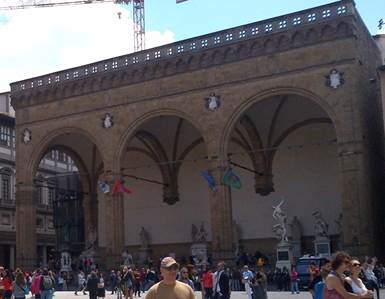
[-Ignore the copies of
Michelangelo’s David (the real one is in the Academia) and Donatello’s Judith
and Holofernes (the real one being upstairs in the Palazzo Vecchio; and I am mortified
that in the original edition of this guide I had suggested that it might
suffice to look at this terribly inferior copy).]
Palazzo
Vecchio (
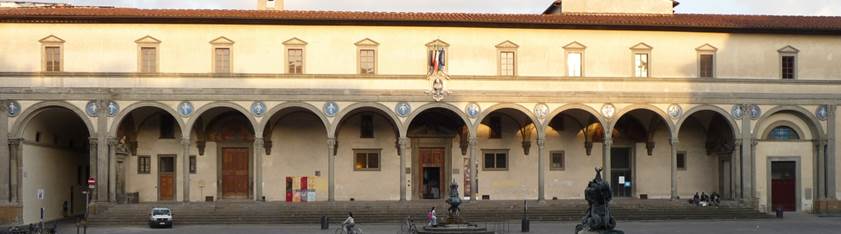
Loggia del Ospedale
degli Innocenti (Loggia of the Foundling Hospital –out of chronological
sequence here: it should certainly follow
Santa Croce, but since your visit there will also expose you to one of
Brunelleschi’s important, developed, later works [the Pazzi Chapel], it’s
important to see this first) –1419 design
by Brunelleschi, completed 1424. (It is the outside loggia
that is important; the rest of the building was done by Brunelleschi’s
students.)
This
single example marks the true beginning of Renaissance architecture. (q.v.,
Bates Lowry, Renaissance Architecture.)
It all begins here!
Brunelleschi has gone back to classical forms –rounded arches with a
horizontal element above them, Corinthian capitals, pilasters, and, behind, a
vault that is formed by a series of small domes (carried on the columns of the
loggia and on corbels on the surface of the hospital wall, creating square bays
that are not cross-vaulted as they would have been in a Gothic design, but
purely classical shapes) – that had not been utilized since antiquity. He has integrated these classical elements
with elements of the Italian Romanesque (e.g., using dosserets over the
capitals) and some of its feel (e.g., the horizontal emphasis). It
should be remembered, however, that Brunelleschi –like other Florentines–
believed these Romanesque elements were examples of classical
antiquity.) But he comes up with a sense
of lightness, rhythm, and rational “grasp-ability” that was new and different
from anything before it. No distracting
ornamentation, no mystifying and humbling sense of inhuman scale –but rather an
understandable, mathematically proportioned space that feels immediately
comprehensible by the viewer. Grand only
in its simplicity. One can detect the
influence of this design in the work of Masaccio and Donatello –as early as in
Masaccio’s Holy Trinity and the niche Donatello and Michelozzo designed for Or
San Michele, both done in the mid-20’s.
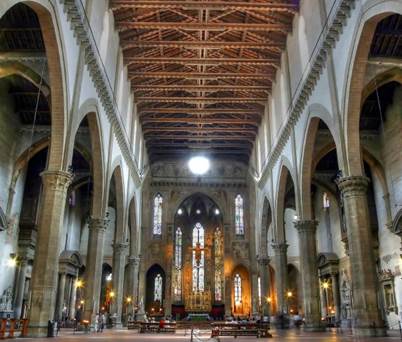
Santa Croce {Mon-Sat, 9:30-5:00; Sun, 1-5:00} (there is now an
admission fee charged to enter the church, but in includes entry into the
museum and Pazzi Chapel [see below]; buy tickets around the left outside wall
of the church) - another major example
of the Italian Gothic by Arnolfo di Cambio, begun in 1294. This is a Franciscan (absolute poverty as a
principle –remember?) church, which was built in competition with the Dominican
Exterior: Like so many,
actually 19th century.
Interior: Again, a very
Italian Gothic feel; but note the open timber ceiling (rather than having the weight
of masonry vaulting, this form is much lighter, permitting lighter support
columns that lend an airier feel), and the different proportion between the
nave and the aisle bays (bays are longer and shallower, giving a little less
typical Italian feel –but still unmistakably Italian).
Going
down the right aisle [quickly get by Michelangelo’s tomb *XX*] -
Annunciation
by Donatello: Toward the apse end, on the right wall of the
aisle of the nave; done in gilded pietra serena (that gray stone mentioned above), ca. 1428-33.
Check out the marvelous composition:
the balance of the angles and forms, the movement from the angel to Mary
–and yet the emptiness of the tension-filled space in-between them, and the
reaction of her body –startled and starting to move away, but drawn back by the
angel’s gaze (note the visual connection between their eyes and faces), the
emphasis on the dramatic moment. Look at
her face –one of the few really beautiful female representations in the art of
this period; and look at her emotions.
And do not ignore the compositional suggestion of the force of the
angel’s “message” to Mary –the
intense triangular area of radiation from his center outward towards her. The mutedly implied sexuality is picked up in
the placement of her hands and the folds of her drapery. (The sexuality—implied, denied, and sometimes
rather blatantly expressed—of this pointedly “non-sexual” moment, is a very
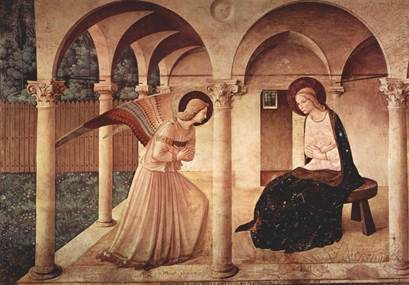
curious element in all Annunciation scenes [cf. the extremely un-sexual, but
incredibly beautiful version by Fra Angelica in San Marco]. Remember, this is the moment that the Virgin
is being “told” by the angel that she is pregnant with Jesus; but is actually
the moment of her immaculately being impregnated by the Holy Spirit. Sexual or non-sexual? You decide.)
[Cappella Castellani: In right (west) side of the right
transept; frescoes by Agnolo Gaddi and
his pupils depicting the lives of the Saints.]
Cappella
Baroncelli: At the end of the right transept; frescoes by
Taddeo Gaddi (Agnolo’s father, and Giotto’s pupil) of the life of the
virgin. The father’s work is much better
than the son’s.
Cappella
Bardi and Cappella Peruzzi: The two chapels immediately to the right of
the altar, closer and farther, respectively; frescoes by Giotto of the
life of Saint
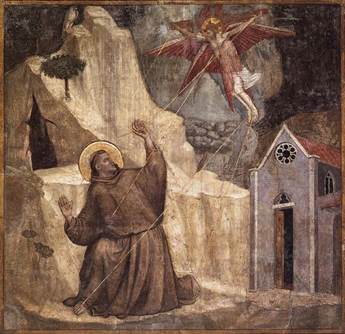
John the Evangelist –the best in
Florence, although they were badly damaged at one point, and their restoration
was not altogether well-done. (The only better Giotto
frescoes –and they are much better– are in the Cappella Scrovegni in
Padova.)
Although
clearly a medieval painter, Giotto represents a major move forward towards the
Renaissance; and, while not actually a part of the Renaissance, his work has
elements and implications that formed the major influence in the tradition of
Florentine painting that led eventually to Masaccio. Figures begin to have much more material
existence and corporeal presence in the painting of Giotto. He employed contour line, modeling, and shading
to create a sculptural presence in his figures.
His people have far more personality than those of any prior medieval
artist, or any subsequent one for almost 100 years. He also demonstrates a masterful grasp of
composition: the arrangements of the
elements to each other (and to the plane of
the fresco wall) is carefully integrated into the overall design. Each grouping within a fresco has its own
compositional integrity, and together they form a powerful and expressive
rhythmic whole. The best of these frescoes is The
Apotheosis of St. John the Evangelist (the lower panel on the
right wall of the Cappella Peruzzi, the chapel on the right). The action is framed and balanced by the two
groups of figures, one on either side of the main action, and each contained
within its own architectural space. In
contrast to this grounded and static base, the center of the space opens to
allow the movement of Saint John ascending heavenward –rising through the
opening architecture toward the angel coming forward to receive him from
above. Note the personalities in the
faces, the sculptural feel of the drapery, and the beautiful use of color. The Death of St. John the Evangelist
is a similarly wonderful example. These
two works, alone, merit spending significant time standing and absorbing, as do
some of the lesser works of these two chapels.
Crucifix
by Donatello: In the left
transept. Ca. 1412, and thought to have
been done as part of a friendly competition with Brunelleschi. Wonderful, but difficult to see well.
Cappella Pazzi and
Museo dell’ Opera di Santa Croce: (while there had been a separate entrance
[and admission fee], these are now entered through the right side of the nave
in the church itself, without any separate admission fee)
Museum:
Crucifix
by Cimabue: (Immediately
to the right when you enter) Although
tragically damaged in the flood of 1966, this magnificent painting by Giotto’s
predecessor (and probable teacher) is quite moving. Cimabue has far more Byzantine influences in
his style (this
Byzantine influence is characteristic of the Sienese tradition of painting, by
the way) than Giotto ever was affected
by, but his painterly quality and interest in the human form was extremely
important in Giotto’s development.
Last
Supper by Taddeo Gaddi: Wonderful fresco at far end of the room.
Pazzi
Chapel by Brunelleschi: This marvelous little building was planned in
the mid 1430’s by Brunelleschi (and thus is out of chronological sequence here. If possible, it is far preferable to see the
Sagrestia Vecchia at
Taking the radius of the dome over the central square here to be one unit, “r,” the sides of the central square are 2r in length. On the wall opposite the entrance, there is an opening for the choir, which is a square 1r on each side, and covered by a dome, the radius of which is ½r. On either side of the central square Brunelleschi added small ‘transepts’ which extend the width of the interior space ½r on either side of the central main square under the dome–effectively resulting in lateral areas equal to the opening of the choir (1r) on either side of the choir, and creating a total width of 3r. In elevation, the chapel is divided into two zones of equal height (2r each): the lower consisting of the flat side walls up to the top of the main entablature; the upper half being sub-divided by a smaller entablature into two equal zones of 1r each –the upper of these being the hemispheric dome, and the lower containing in the four corners pendentives, spherical triangles which transform the square into a circle to accommodate the circumference of the dome. The square choir space is balanced by a square entry vestibule outside the doorway, which is extended on the exterior by 1r square areas on each side –creating an overall width that is 3r (three of these units), and covered by a very classical, heavy barrel vault with a central, defining dome shape over the entry vestibule.
What
results is a space that exists in a mathematical relationship of its constituent parts. This form results in an almost musically
harmonious feeling: one is within a
spatial harmony, with various overtones.
The rhythms and harmonies are emphasized—and, perhaps, over-emphasized—by
the pilasters and trim on the walls and the patterns on the floors–which are
created by and therefore echo the underlying mathematical relationships. This is a space that the human mind can grasp
and be at peace with. It is stately and
grand, but in a quiet, stable, and tranquil way. Spend some time just sitting in this space to
get the feel of it. It’ll do you
good! But the amount of decorative detail
results in its being not nearly as calming or successful as the less adorned,
subtler space of the Sagrestia Vecchia
of
Special Note: Anytime you
are in the area of Santa Croce, don’t miss the
opportunity to stop in at Vivoli (via Isola delle Stinche 7r,
between via Burella and via della Vigna Vecchia)
to have the best gelato in
Il Bargello: (“The
Captain of Justice”) {8:15-1:50; closed the 2nd and 4th
Mondays and the 1st, 3rd, and 5th Sundays of
each month} This trecento palace was
the first town hall, and the site of numerous public hangings. It also contains some of the world’s greatest
sculpture. Take in the look and feel of
the main courtyard.
Ground
Floor: Some lovely Michelangelo works: Brutus, Bacchus, the Pitti Tondo (i.e., round
medallion), and a David (that isn’t so good); [also, lots of Giambologna, if you are so
inclined (actually, the Hermes is quite wonderful); and Cellini, if you must.]
First
Floor: (go up outside staircase from central
courtyard, if it’s open [otherwise, use the stairs inside, across the
courtyard]; and take in architecture at the top of stairs. Then turn to your right to enter Sala di Donatello.) On your way out of the Sala di Donatello, it
is well worth looking at the bronze birds by Giambologna in the open
balcony—they are truly wonderful in a humorous, almost modern way, that always
puts me in mind of Picasso’s ceramic birds, and especially his owls. [There are some other interesting things on
this floor and the one above, but nothing important.]
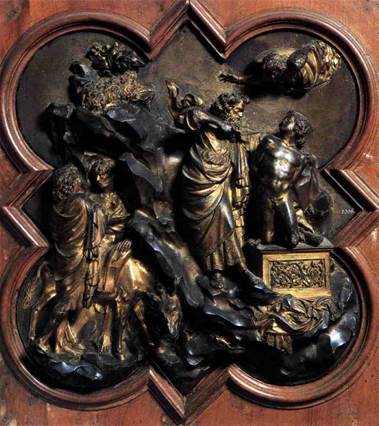
Competition
Panels: (On the back wall, to the right of
Ghiberti: The winner,
and deservedly so. This panel works
better: it is beautiful and powerful and
has a more polished style. His
composition uses the Gothic form of the quatrefoil to maximum advantage.
There is more depth to the space he creates. The strongly modeled figures twist gracefully
in a in rhythmic overlay that represents the ultimate refinement of an International Gothic feeling. The angel sweeps forward out of the pictorial
depth. The mood is actually gentle,
given the subject matter: it represents
a pause in the action, reflected in the balance of the composition.
Brunelleschi: Also
magnificent, if not nearly as elegant. A
shallower, more rigid composition, with the figures and landscape elements more
sharply separated –in a way that lends an almost abstract quality to the
space. Note the focus on the intensity
of the human emotion (e.g., the expression of horror on Abraham’s face
as he moves into the action, and the fear in Isaac’s face) and on the crucial
moment of the action: the powerful
thrust of Abraham’s arm as he forces Isaac’s head back to expose his neck; the
knife poised at the moment of being thrust into Isaac’s throat; the force of
the angel coming in from the left, his outstretched arm countering the thrust
of the knife. The tension of the drama is
caught at its highest point. The
conception of human life with which this relief is imbued has far more to do
with what is to come in the Renaissance –and with the work of Donatello, in
particular.
Donatello:
Marble
David: (1408-9)
Perhaps his first major work. The
idea of presenting David as the youthful victor over Goliath may have
originated here with Donatello. This is
a work poised between the International Gothic and the Renaissance: its style is quite linked to the works of
Ghiberti, and yet there are, particularly in the face, hints of individuality,
humanity, and classical beauty. Also,
more effeminate than one would have imagined David as being (note the similarity to the
face of the Virgin in the Annunciation in Santa Croce).
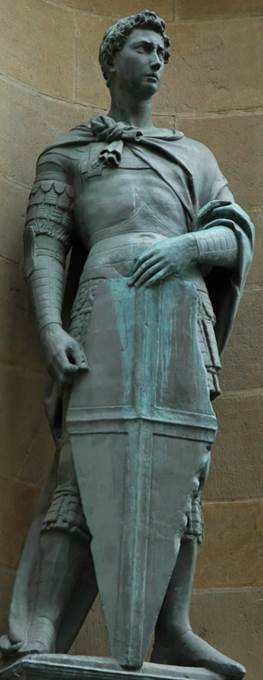
St.
George Tabernacle: (1415-17)
Done for the Armourers’ Guild for Or San Michele.
Niche: The depth of
the architectural setting for San Giorgio was restricted because the site it
was designed for had a staircase in the wall behind which didn’t allow for the
same depth as the normal niches.
Donatello has used this situation to marked advantage here,
however: he allows the shallowness of
the space to project the figure out into the space of the real world. (It has been suggested that the statue originally
held a sword in its right hand, which would have even more dramatically
projected the figure out into the space in front of the niche.) This figure
dynamically emerges out into the world in a way no other statue on Or San
Michele even approaches.
San
Giorgio: Strikingly posed with his weight unevenly
distributed towards his left foot while his body turns toward the right, the
statue conveys the sense of fear, doubt, and inward struggle for decision to
take action. And inward struggle,
decision, and interior crisis are what Donatello is most wonderfully
about. (My undergraduate dissertation was about
Donatello as a creator of art imbued with a tragic sense of life –which, I
believe, is all about such inner struggle and taking action in a world in which
rationality can be sought, but in which not everything succumbs to the desire
for rationality.) This young warrior-saint is heroic, yet not
without anxiety; his complex human emotion is clearly evident in the dramatic
moment of inner tension captured by Donatello.
San Giorgio sees the task before him and is summoning up his courage to
confront it—but he is in no way certain that he will prevail. The only certainty is that he will undertake
the task.
The
Relief Sculpture: Don’t overlook the incredible marble schiacciato
(“flattened-out”) relief under the statue itself: it is the representation of St. George
slaying the dragon. Here is a different dramatic moment, at the height of the
action. Note the incredible space and
depth Donatello has created in this very shallow, schiacciato relief (this panel is the first real
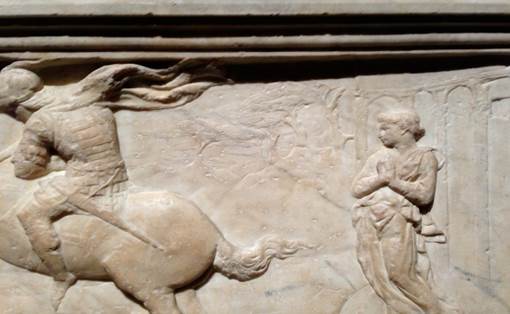
example of this form which was to become an important Florentine style): both through
the use of linear perspective in the building on the right (it is worth noting that
this example of linear perspective predates its appearance in any painting –let
alone any other sculpture– by a minimum of five or six years!) and through the use of chiaroscuro (light and shade)
and atmosphere (check out the wonderful trees in the background between St.
George and the maiden). Notice the
horse, and especially how well he is able to sculpt its head using virtually no
actual depth at all on the relief plane.
This schiacciato technique respects the integrity of the surface of the
relief in a way that creates a tension between actual surface and pictorial
depth that becomes increasingly important in Donatello’s later reliefs. Even the dragon’s cave is wonderful.
A
new speculation: On our 2003 visit to
Il
Marzocco: (“The Lion of Florence” - 1418-20) Distinguished by the way the animal visage is
suffused with the expressiveness and nobility of Donatello’s human forms –this
is one hell of a lion!
Bronze
David: (1430-32)
This is the first totally free-standing sculpture (intended to be viewed in
the round as opposed to in a niche) and
the first nude sculpture since classical antiquity! While what is most immediately striking about
this David is that he is presented as a highly erotic, extremely effeminate,
beautiful young boy, note also the tremendous classicism of the form and
pose. Also, the specific proportions of the figure exactly
replicate those of the norm in classical
Niccolò
da Uzzano: (ca. 1460-80)
Very moving human depth in this bust.
Crucifixion: This very
late (ca. 1470-80) bronze relief was probably designed by Donatello, as it has
some of his feel; but it was almost certainly executed by his students, as it
just isn’t quite up to his standards in certain important ways.
San Lorenzo: {Mon-Sat,
10-5} Brunelleschi did his design for this church starting about 1419, although
much of the work on it did not get done until the ‘40s, and it was not
completed until long after his death in 1446.
The
basic type of the church is quite closely related to that of the Italian
Romanesque: the flat roof of the nave
rising above the aisles, the aisle bays are topped with simple domes, the use
of dosserets above the capitals. The
details, on the other hand, are elements straight out of classical
antiquity: the pilasters, the elegant
columns, the capitals, the coffered ceiling.
The precise mathematical harmonies of the space are pure Brunelleschi,
however: the domed crossing of the
church is a square unit that is repeated on each side to form the transept, and
repeated behind the crossing for the choir; the nave consists of four of these
units, flanked by 8 square aisle bays on each side –each one half the side of
the major square, and, naturally, one fourth the area. (For those who like the problems: the fact that the side chapels were so high
off the floor meant that, in order to have the columns be the same height as
the pilasters on the side walls, he had to utilize very large dosserets over
the capitals to make up for the difference in elevation; he solves this problem
at Santo Spirito.) Here, once again, we are in one of the spaces he
created that is both light and grand, understandable yet impressive, rhythmic
yet stable; and the trim and architectural decorations all combine to enhance
these effects.
Twin
Bronze Pulpits by Donatello: ca. 1460-66
(on both sides of nave at front)
South
Pulpit: (on right) This is an incredible
masterpiece. The side facing in towards
the nave is a Resurrection, in which Jesus harrows Hell and then
rises. The picture of Jesus is unique in
all of the art of this period: one can
see the human dimension of his struggle and suffering. He does not rise from his time in the
underworld triumphant and untouched (as in the typical iconography): rather he is haggard, weary, and tattered
from what he has endured. Jesus drags
himself out of Limbo, his face drawn and his eyes squinting from the
strain. It is a vision that is unique
even for the Renaissance: it is not a
picture of the triumph of reason, or of the victory of human (or divine)
striving over all obstacles; it is a picture of the most intense striving
against forces that do not so easily yield to these efforts. Again, it is a tragic view of life.
North
Pulpit: (on left) Crucifixion stories. Note particularly the marvelous architecture
spaces created in the reliefs and the way they frame, emphasize, and enhance
the action. One of the most wonderfully
unusual reliefs on this pulpit, Christ Before Pilate, Donatello
treats the psychology of the theme of Pilate in a totally anomalous way: Pilate is usually represented as evil (and
often portrayed as in league with the devil), and sometimes represented as a
saint (as in the Ethiopian Church); but Donatello, always attuned to the nuance
of moral dilemma in the human situation, treats him as an individual facing an
impossible decision. His “alternation”
and indecision is represented by the extraordinarily unusual symbol of the
servant who is bringing Pilate the water with which he will eventually ‘wash
his hands’ of the situation: this
servant, immediately behind him, is presented as a two-faced Janus figure. In this unprecedented iconographic departure,
Donatello is clearly emphasizing the indecision and moral dilemma Pilate faced
in making his judgment: he found no evil
in Jesus, yet he was unable to dispute the charges of his accusers.
Sagrestia
Vecchia: {now open whenever the
main church is} Brunelleschi’s Old Sacristy (entered from the left side of the
transept) If you are like us, you will want to be able
to be inside this architectural masterpiece for the better part of an hour. The plan was
done in 1419, and the actual building was done 1421-1428, well before the rest
of the church, and therefore really a building in its own right. It is the first centrally planned
building of the Renaissance –and it is a true marvel.
The main area is a square with a hemispheric dome over it. Assigning “r” as the radius of the dome, the
sides of the square are 2r in length. The one side is divided into thirds (each
section therefore being 2r/3 in width), the central one being opened up to form
the entrance to a small altar, which itself is then a square (2r/3 on a side)
with a hemispheric dome (radius=r/3). The main space is horizontally divided
into three elevations: the lowest level consists of the side walls, which rise
flat up to the entablature; the middle level consists of the continuation of
the side walls up to the level of the springing of the dome –the four corners
of which are formed into pendentives, spherical triangles which transform the
square into a circle to accommodate the circumference of the dome [It has been
speculated that this particular section of Brunelleschi’s design may have been influenced
by his friend, Donatello, who also did the round reliefs that decorate the four
pendentives.]; the third is the hemispheric dome itself. The dome is, of course 1r in elevation, as is
the middle level with its pendentives.
There are many claims made as to the elevation of the lowest level and
its relationship to the whole –all of them erroneous! [The people at the church
itself claim that the building consists of two cubes (of 2r on a side) on top
of one another: the top one consisting of the upper two sections, and the
bottom one consisting of a cube in its own right, therefore claiming the
elevation of the lowest level to be 2r. One scholarly work by Peter Murray
claims (and has a diagram to demonstrate it) that the lower two levels
form a cube –with the elevation of the whole being divided into three equal
heights of 1r each.] On extremely careful observation, Nancy and I are
completely convinced that the height of the lowest level of the space is, in
fact either 2r/3 or 3r/4 (it being impossible to estimate any more closely than
that); but that it is definitely not either 1r or 2r. The pilasters
which carry the entablature are modified Roman forms, much like those
Brunelleschi used in the Loggia of the
But
what is going on in this building goes far beyond the mathematics of the
underlying relationships: just as the mathematics
underlying musical composition are only implicit in the actual experience of
the music when heard, it is the magnificent feel and experience of this space
that matters. The space Brunelleschi
creates is truly encompassing in a way that is not at all overwhelming. This is a space designed to be grasped
by the people in it: it is
understandable, comfortable, yet inspiring.
Once again, I return to a musical metaphor: the mathematical interrelationships are
experienced as harmonious, even without one’s direct consciousness of their
existence. (In his latter version, the
Pazzi Chapel, Brunelleschi’s use of ornament makes these relationships more
insistently present in the experience, in a way that makes it not nearly as
effective or successful as it is here.)
It is a space that has been created by man’s rationality, and it feels
understandable to those in it. Here is
truly a place to spend some time in order to absorb the feel of what the Renaissance is all about.
Donatello’s
Pendentive Sculptures: These scenes from the life of
Other
Sculpture by Donatello: The bronze doors of the martyrs and of the
apostles; the reliefs in painted stucco over the doors of Saints Stephen and
Lawrence and Saints Cosmas and Damian; Four Evangelists (about which there is
much question as to the artist); there is also an absolutely beautiful bust of
San Lorenzo on a counter on the entry wall (despite the magnificence of this
piece, its attribution to Donatello has
been severely questioned.)
Cappelle
Medici: *XX* One enters through the back of
Sagrestia
Nuova: Begun by Michelangelo in 1521 and completed
by Vasari in 1555, it is architecturally restful after the Cappella Principi,
but not in comparison the Sagrestia Vecchia of Brunelleschi. Some good Michelangelo sculptures: Dawn and Dusk (on Lorenzo’s tomb) and Night
and Day (on Giuliano’s tomb, opposite).
If you check out the female anatomy, you realize the big M wasn’t
terribly into the female form. There is
also a Madonna and Child by him.
Museo di San Marco: {8:30-1:45; closed 1st, 3rd,
5th Sundays of each mo., and 2nd, 4th Mondays} The (eventually Dominican) church and monastery of
San Marco, built in 1299, were the home base of Fra Angelico (and
Savanarola, too). As such, it houses the
best, most loving, beautiful paintings he ever did. While Fra Angelico (cited as “Beato [Blessed]
Angelico” in this museum) is not part of the same humanistic spirit that lay at
the heart of the Renaissance, his paintings, particularly here in his own monastery,
are so wonderful and sensitive that they bear special attention (look
particularly closely at the faces: not the monumental humanity of Masaccio and
Donatello, but a spiritual beauty, instead).
On the ground floor, immediately to the right as you enter is an area
that houses twenty of his magnificent works.
There is
also a wing that houses architectural fragments from various sites in
Museo dell’ Opera del
Duomo: {Monday-Saturday
9-7:30, Sunday 9-1:40} This may be my favorite place in
Ground
Floor:
Brunelleschi
Memorabilia: Fascinating collection of things made,
designed, and used by Brunelleschi in constructing the dome, including a model
for the dome itself.
Sala
dell’Antica Facciato del Duomo: (Room of the Old Façade of the Duomo) Various sculptures and architectural details
from the old façade, including works by Arnolfo di Cambio (architect for the
Duomo and many other Italian Gothic buildings in
Nanni
di Banco: Marble statue of a seated St. Luke (1408-15) by this contemporary of Donatello. He was an important reviver of ancient Roman
forms, and therefore valued the effects of weight and mass in sculpture. This work is
quite wonderful–note especially the tilt of the head, the face, and the way the
lowered eyes create a look that meets and holds your gaze.
Donatello: Seated
Mezzanine: Half way up
to the second floor is Michelangelo’s Pietà (ca. 1550), originally
designed for his own tomb. The story
goes that Michelangelo smashed the work, which was later reassembled by a
pupil, who completed the figure of Mary Magdalene.
Second
Floor:
Main
Room - Donatello:
IMPORTANT: The four statues of prophets (and the Abraham and Isaac) made for the
façade of the Campanile (the first five in the following list) must be
viewed from sharply below in order to see them as Donatello meant them to look! As you saw
from the placement of the copies on the Campanile itself, they were positioned very
high up, and, as discussed in describing the
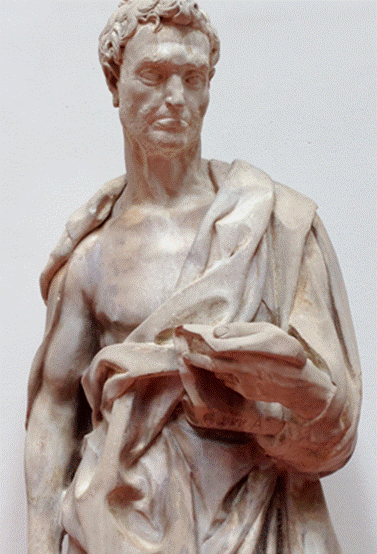
Beardless
Prophet: (1416-18)
The earliest of the prophets. The
head is particularly interesting: it
clearly is based on classical Roman portrait types, but it also has an
extraordinary level of individuality and of realism in the portrayal of age and
suffering –yet not without firmness and resolve. Donatello at this early stage in his career
is beginning to explore the realism of physical and psychological experience,
in a way that is to reach fruition in Lo Zuccone and Il Popolano (q.v.,
below). The hands are also marvelously strong –particularly the right hand,
with which the prophet insistently points to the scroll containing the message
he has been charged to deliver. It has
been speculated that the weaker drapery of
this figure is attributable to its having been executed by Donatello’s
assistant Nanni di Bartolo, known as Il Rosso.
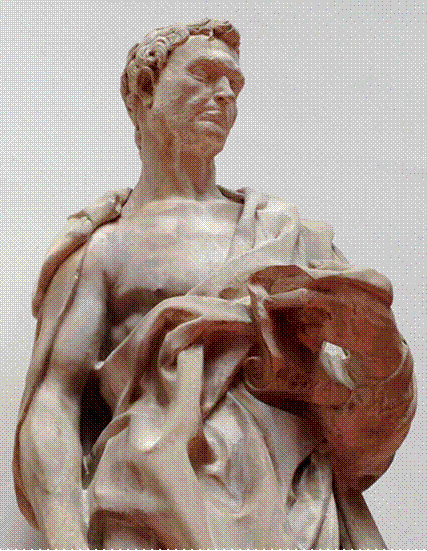
Bearded
Prophet: (1418-20)
This figure is far more pensive than its slightly earlier companion, yet
it lacks none of its power. There is the
suggestion that this prophet is someone who has faced adversity; yet the
monumentality and a nobility of the form, reflected in the power of the
drapery, reassures us that he has not been shaken in his resolve. There is an unmistakable individuality and
vivid personality in the face.
Abraham
and Isaac (done with Il Rosso): (1421) While
the design of this piece was certainly Donatello’s, the execution was done in part
by his assistant. The complex,
intertwined composition must be Donatello’s.
In this piece, the height of the dramatic moment has passed. Unlike Brunelleschi’s competition panel of
this scene, which captures the very highest point of the tension and drama,
here the tension is beginning to relax:
Abraham’s right arm is starting to slacken, and the knife is slipping
away from Isaac’s throat; Isaac is in a state of passive acceptance; the angel
has come and gone. Nevertheless, what
remains is the close, human contact of this father and son, with nothing to
mitigate the immediate implications of what Abraham had been about to do. Abraham’s pained expression gives the
impression that he is well aware of the horror of the deed he had been about to
commit.
Lo
Zuccone (?Jeremiah): (1423-26) The reason for the question
marks in the title of this and the next prophet relates to the fact that there
is a controversy as to which is which.
The descriptive names, “Lo Zuccone”
(“The Pumpkin-head”) and “Il Popolano” (“The Man of the People”), are not in
dispute, but the names of the prophets they represent are, as are the dates
which apply to each. (The Habakkuk [as
referred to in the records of the time] is the later of the two works, but it
is not clear to which of the actual statues this name –and therefore this
dating– applies. I have chosen to list
and date them as Janson and Seymour do; but this is not conclusive. Traditionally, the opposite view is held to
be true—and that is how they are labeled in the Museo del Duomo.) So I’ll stick to using the descriptive names
for practical purposes.
Il
Popolano (?Habakkuk): (1427-35)
-believe it or not, this statue –which is my number one choice for best sculpture of all time– is
still off being restored—and has been for at least the last three years! Sorry.-
By
your leave, I am here going to quote from my undergraduate dissertation, Donatello
and the Tragic Sense of Life.
(Please pardon my 21 year-old prose, which itself is now four decades
old!):
Donatello most fully realizes the tragic potential of the prophetic theme in his last two prophets, Il Popolano and Lo Zuccone. In these two figures Donatello embodies all the powerful human drama of tragedy.
Il Popolano is a
strong-willed, determined man who faces his task with unswerving
directness. Donatello has depicted him in the very act of delivering his
message: in his left hand he clutches the
scroll which contains that message. This
is not a scroll which he displays, as did the Beardless Prophet. That earlier prophet was cast as a Roman
orator, and his scroll was a formal device of rhetoric, used by him as a
prop. The scroll of Il Popolano is not
something he uses visually to inspire his audience; on the contrary, it is
something from which he draws his personal inspiration. This scroll is his own little fragment: it is a humble document, crumpled from long
use. It draws its significance not from
its physical characteristics, but from the moral importance of its contents;
and it becomes an important part of the statue not through optically asserting
itself on the viewer’s senses, but through psychologically asserting itself on
the viewer’s overall comprehension of the work.
It is important to the statue because it is so greatly important to the
prophet. The scroll symbolizes the
message to which he has chosen to devote his life. He faces his people to propound that message,
holding his scroll before him almost as if for moral support.
It must be remembered that
the message of the prophet was never an easy one for his audience to
accept. The Old Testament prophet had a
message that was primarily moral and a role that was essentially that of social
reform. His was the difficult task of
convincing his fellow men of their injustice and iniquity. Moreover, he had to get them to change their
ways. People are never readily convinced
that they should change. Thus the work
of the prophet was always met with much resistance.
Il Popolano would appear to
react angrily to the resistance he meets in propounding his message. The intense furrow of his brow, his tight
frown, the tensed muscles of his face, the strained sinews which stand out on
his neck—his expression reveals an angry disapproval, not only of his people’s iniquity,
but also of their blindness. He has
tried to warn them, and they have not accepted his message.
Il Popolano looks angrily
away from his people. His gaze is off to
the left and up—above the heads of his audience. He averts his gaze not to ignore his people
and become introspective, nor to turn to an ascetic mysticism by withdrawing
from the demands of the situation, but rather to gather his energy for another
volley. He is disgusted with his people
and his entire figure reflects the tension of his anger: the muscles of his right arm are tense and
strained, causing the veins to stand out sharply; his right hand is angrily
pressed so hard against his thigh that it gives energy to the powerful
undulations of drapery that seem to spread away from this gesture as ripples
spread from a disturbance on water.
Nevertheless, he will not abandon those who have caused this anger. The determination in his gaze is as obvious
as the anger, and in his entire figure one feels a solidity that reflects his
resolve. His strong conviction obviously
will triumph over those feelings which try to shake it. He looks away to regain his composure, but he
will again return to his task. He faces
great adversity, but he will never yield to that adversity.
There is in Il Popolano a powerful
realization of the tragic implications of the role of the prophet. In it one can see what it means, in human
terms, to devote one’s life to propounding a message that people do not wish to
hear. One feels with the prophet the
anger and frustration of being rejected by the very people to whom he has
dedicated his life. One feels the
suffering of a man who is willing to step outside the system and question
accepted norms. In the fiery spirit
of Il Popolano, Donatello seems to have
recaptured something of the Old Testament, tragic concept of the prophetic
life.
This
is a work of art that is imbued with psychological complexity, intense emotion,
human nobility, and a view of the world –and of human action within it– that is
radically different from everything which has gone before it. Allow yourself to stand (or, more correctly,
sit) it awe of it.
Mary
Magdalene: (1454-55)
This wooden statue once stood in Il Battistero; but, after having been
terribly damaged in the flood of 1966, it was moved to the Museo del
Duomo. It has been extensively restored
and painted–and finally it again looks like I originally remember it. It is still a striking work, however: the harshness and extreme suffering so clear
in this haggard creature was a major departure for Donatello, and was said to
have evoked a large degree of religious fervor in those viewing it. It has even been suggested by Janson that it
foreshadows the shift towards such fervor that ultimately culminates in the
ascendancy of Savanarola, whose turning away from the rationality of the
Renaissance towards older religious fundamentalism marked the later years of
the quattrocento in
Cantoria: (1433-39,
over the statue of Mary Magdalene) This
was probably really an organ loft. It is
by Donatello, and it is a brilliant work, although it s not the part of his
talent I am most interested in.
Main
Room - Work of others:
Cantoria
by Luca della Robia: (opposite one by Donatello) Even less interesting than
Donatello’s.
Sala
delle Formelle: (“Room of the Panels”)
Eight
Panels from Ghiberti’s “Gates of
The
room off the other side of the Main Room: This room is full of very interesting
architectural details, mostly from the façade of Il Campanile.
Orsanmichele: In the center
of
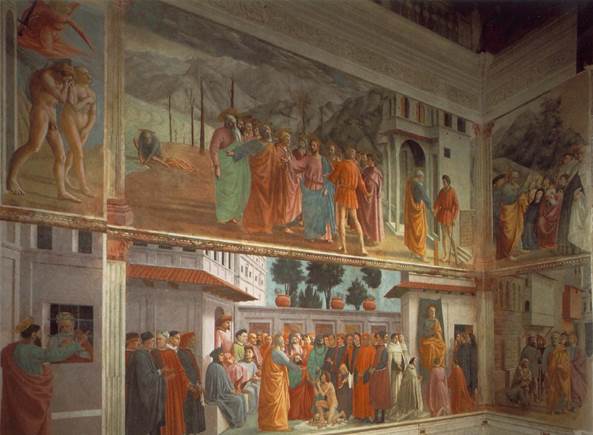
Cappella Brancacci in
Santa Maria del Carmine: (the entrance is through a door to the right
of the façade of the church; there is a fascistic and ridiculous system imposed
on visitors: you wait for ~15 minutes until you are allowed to go in through
the cloister to the ticket office, where you buy your ticket and then have to
wait another 15 minutes until you are allowed into the chapel, where you are
allowed exactly 15 minutes to view these magnificent frescoes. It is truly absurd, and, were it not for the
importance and beauty of the art, I’d refuse to consider doing it.) This chapel
in this Oltrarno (other side of the
The
Expulsion from the Garden of Eden: The first of the great contributions of Masaccio, on the top left of the chapel as
you enter. This fresco captures the
essence of the Renaissance spirit: man,
even as sinner, has unlimited dignity and stature. There is a strength and monumental presence
in the form of these figures –not to mention a classical beauty. They, and Eve in particular, capture the full
extent of pain and suffering in the human condition. Masaccio captures emotion and dramatic
intensity to an extent unparalleled by other painters of his day –but very akin
to the spirit captured by Donatello.
Note also the composition: the
fiery red angel above pressuring them out of the Garden with the weight of his
powerful gesture and creating the movement at the heart of the theme. (cf., the Temptation of Adam and Eve by Masolino,
opposite: a wonderful work, but with
none of this humanistic emphasis.)
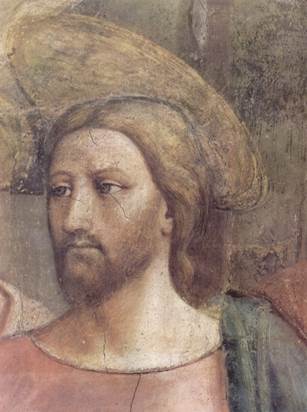
The
Tribute Money: (immediately to the right of the
Expulsion) Here Masaccio presents three
separate moments in the story: in the
central space, the tax collector makes his request and Jesus replies with
directions to St. Peter; to the left,
Peter catches the fish and takes the coins out of its mouth; on the right, Peter hands the money over to
the tax collector. (It has been suggested that
the theme was chosen and presented this way to help elicit support for the
collection of a new tax in
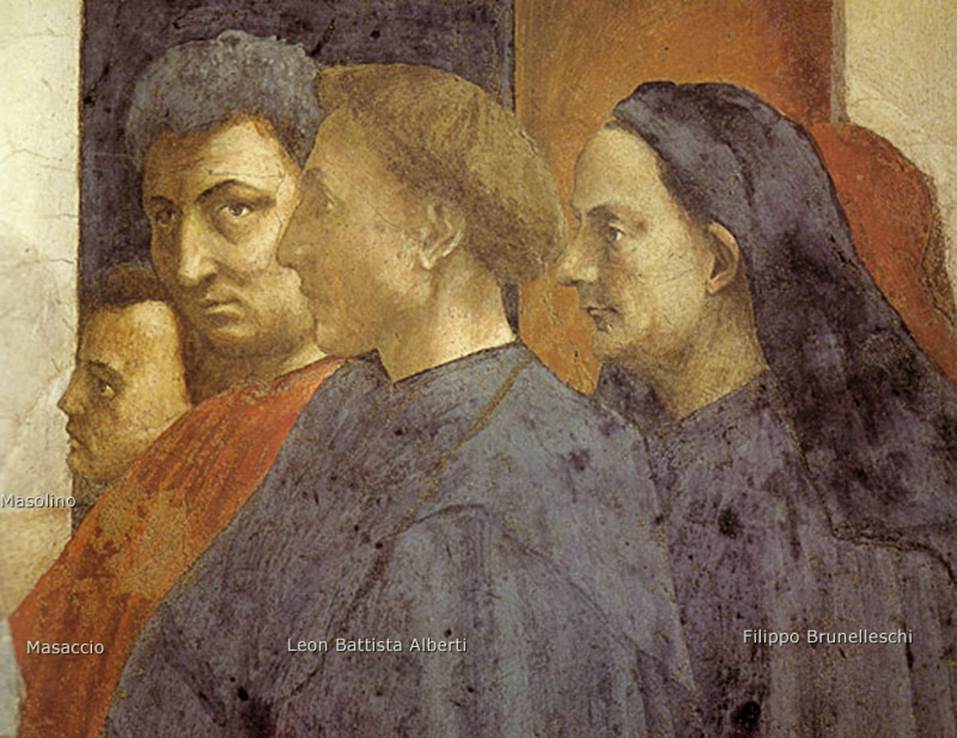
The
Raising of the Son of Theophilus and Enthronement of St. Peter: (directly
below Tribute Money) This was most
probably designed by Masaccio, although there are many hands involved in the
execution. In the Enthronement
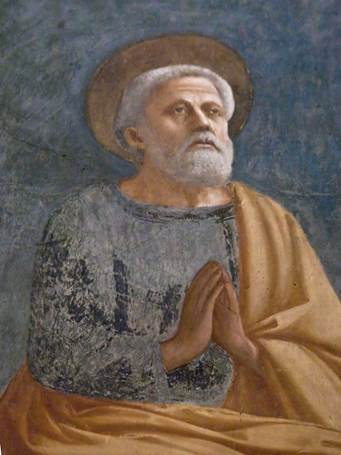
scene on the right, it is clearly mostly Masaccio –particularly St. Peter and
the four figures at the far right (which are actually portraits of [from left
to right] Masolino, Masaccio, Alberti, and Brunelleschi, with Masaccio facing
out at the viewer).
Other
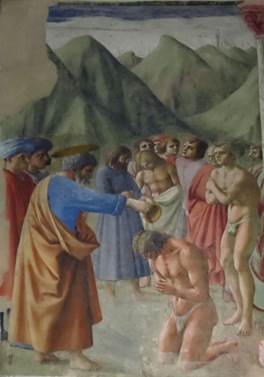
stuff by Masaccio: Most authorities believe The Baptism of
the Neophytes (to the right of the window, above) is by Masaccio; similarly
the one of St. Peter Healing the Sick with his Shadow (to the left of
the window, below).
Most
of the rest is by Masolino, with some later work by Filipino Lippi (e.g., St. Peter in Prison –under the
Expulsion, on left); all far less interesting than the astounding works of
Masaccio.
Santo Spirito: {8:30-12, 4-6; closed Wed. afternoons} This church
is the culmination of Brunelleschi’s development. It was commissioned in 1434 and begun in 1436, and
it therefore represents his latest and most mature style. Also, in this church he was not encumbered by
an existing building program –so he could plan it exactly as he wished it to
be. It was not completed until 1482, 36
years after his death, however, and there were many controversies that resulted
in alterations to his plan: the main
ones involve the front of the church, which was supposed to have a continuation
of the domed square aisle bays that he carefully continued around the entirety
of the rest of the design (and, therefore, there should have been four doors on
the west end of the church); and the
exterior was to have reflected on its surface the semicircular shape of the
chapels, instead of being filled in flat as it is (this, more than any other
detail, reveals Brunelleschi’s connection to Romanesque architecture; in this
regard, notice also the strong horizontal emphasis.). The basic plan is not unlike that of
San Miniato al Monte: This little
treasure is perched on a hill with the best view of
Interior: Note the
rounded arches carried on columns that separate the nave from the aisles. These forms are reminiscent of those later
used by Brunelleschi, although they are much heavier and more squat. Clearly, he drew on this model, although he
used a very different sense of proportion –and employed mathematical
relationships to create spatial harmonies simply not present here. Nevertheless, this is a beautifully
compelling space. If you have time,
observe a mass being said to get the real feel of the place. In the crypt (behind and below the altar),
are some frescoes by Taddeo Gaddi.
When
finished here, walk down the stairs and turn right until you come to the-
Piazzale Michelangelo: This place
has a great view (and still yet another copy of David), but is a major
tourist stop! *XX* I’d carefully (so as not to get trampled or run over by a
tour bus) hurry through it. Off to the
right begins a path (not the road) that cuts back and forth through
lovely gardens until you reach Porta San Niccolò, a three story medieval tower
near the river. A great walk.
Uffizi: *XX* The collection
of painting here is incredible, but the tourist density can present serious
problems. My main piece of advice here
–and it is a very valuable one– is to tell you that it is possible to
make reservations for the Uffizi by telephone, which allows you to avoid the
line outside, and thus will save you the 2-3 hours of waiting time
before you can get in. At least
10 days prior to your visit (and, in the summer, I’d allow more like 3 weeks),
call 011-39-055-294883 (Mon.-Fri., 8:30-6:30, Sat 8:30-12:30,
Galleria dell’ Academia: The home of
the real David, copies of which are almost as numerous as tourists in
[Palazzo Pitti: If you like
Titian and Raphael, you’ll love this Oltrarno museum –it has many wonderful
examples of both. (see Access:
Giardino di Boboli: This is a low
priority, but, if you have lots of time, the climb through these expansive
gardens next to the
Restaurants IN
Il
Cibrèo: Splendid restaurant, the pinnacle of Tuscan
‘home style’ cooking (but don’t be fooled by that description: it’s a sophisticated operation, and they even
have a branch in
Enotecca Pinchiorri: This
restaurant had been closed for renovations during our 2003 visit, but it has
since re-opened. It is a magnificent
restaurant: beautiful decor, superb
food, unbelievable wine, and perfect service.
It is one of the only restaurants in Italy (and one of only a few
outside of France, actually) to have two Michelin stars—and I suspect it is on
its way to a third Unfortunately, it is
almost obscenely expensive; it was twice as expensive as it was nine years
ago—and more than four times the cost of a lovely meal at Cibrèo. If you do it (and can bear the sticker
shock), though, do a degustazione of food and of wine! Click here for a link to
the food and wine we consumed on this (2006) visit. The first time we were there, I had the gran
menù degustazione: dorad in balsamic
vinegar, foie gras with salad, lobster in a bisque with spring vegetables, a
fresh tomato and vegetable soup, an intermezzo of necce (sp?) –a
chestnut and ricotta confection, medallions of veal, talleggio in mille
feuille, and an apple tart. Our wine degustazione
included a delicious Rothschild white I didn’t know, an all-sangiovese red, a
terrific Bonnes Mares (although, what Bonnes Mares isn’t terrific?), and an
Ornelia (a marvelous Tuscan wine).
Dress is quite formal (jackets required, tie appropriate); reservations
a must. Tel. 242777. Via Ghibellina, 87.
Buca Lapi: “Buca” means
“hole,” but this basement restaurant is a pleasant place for a casual meal.
Great for bistecca alla fiorentina .
They do their meat cutting as well as their cooking in a kitchen that it
is possible to see into from many parts of the restaurant. Good crostini and pastas; reasonably priced
Tignanello ’98 on the wine list. Moderately priced. Informal.
Tel. 213768. Via del Trebbio
(right next to Palazzo Antinori)
Don Chisciotte: A bit more
formal than most places in
Il Latini: A fun place
to eat –very informal, inexpensive, long tables where you sit with other
people, and good food. The house wine (a
chianti in large bottles on each table) is drinkable. The mixed appetizer (which includes
bruschetta, crostini, prosciutto, and salami) is great; the ribollita or
ravioli makes a great first course, and the bistecca alla fiorentina is
reasonable here. The problem is that there are no reservations (no matter what
they may tell you): the door opens at 7:30 exactly, and the mob that has formed
outside simply pushes in. Get there by
7:15 or 7:20 at the latest, and push on in with them! (The place is much
bigger than it appears from the outside, by the way.) Via dei Palchetti, 6r (between v.
della Vigna Nuova and v. dei Federighi)
Not really worth
bothering: Il Garga an informal, not terribly good
restaurant—some passably good pasta dishes, but very mediocre main courses, and
while still moderate, prices far above what the atmosphere and cuisine warrant,
and very touristy; and Alle Murate, a pretentious, over priced place
with some good wines on their list at some good prices (if you know what you’re
looking for), but with what is ultimately mediocre food at a high price. The only
thing that makes it worth considering is that it is one of the extremely few
restaurants in
Padova is worth a trip for
two reasons: La Cappella Scrovegni, site of the best Giotto
frescoes in the world (and a lot of them!); and the Donatello sculpture (our
man spent 10 years in Padova, 1443-53)
in the Basilica of S. Anthony, or
Il Santo, as it is known.
It’s also a pretty interesting town, as it turns out –and the home of
one of the world’s oldest universities, known as Il Bo. One can stay very inexpensively (LIT.
217.000; and comfortably, if in a manner that is in no way charming) at the Hotel
Donatello (yes, that’s right…) immediately across from Il Santo. (Our room actually looked out on Il Santo,
and Donatello’s equestrian statue, Gattamelata.) Walking around the area of the University is
fascinating (it’s about half-way between La Cappella Scrovegni and Il
Santo). Dinner at La Vecchia
Enotecca (near Il Bo) was an unexpected treat: great food, moderately priced, and a
wonderful Barolo, all in a lovely setting.
La Cappella Scrovegni: (or, Arena
Chapel, as it is sometimes called) 1305-6.
Three dozen of the most beautiful, well-preserved works of Giotto. Although clearly a medieval
painter, Giotto represents a major move forward towards the Renaissance; and,
while not actually a part of the Renaissance, his work has elements and
implications that formed the major influence in the tradition of Florentine
painting that led eventually to Masaccio.
Figures begin to have much more material existence and corporeal
presence in the painting of Giotto. He
employed contour line, modeling, and shading to create a sculptural presence in
his figures. His people have far more
personality than those of any prior medieval artist, or any subsequent one for
almost 100 years. He also demonstrates a
masterful grasp of composition: the arrangements
of the elements to each other (and to the plane of the fresco wall) is carefully integrated into
the overall design. Each grouping within
a fresco has its own compositional integrity, and together they form a powerful
and expressive rhythmic whole. In all of these frescoes, try to notice the powerful
composition Giotto uses, and look closely at the marvelous faces –note the
tremendous individuality and feeling, even in the animals, by the way. Plan to spend at least a couple of hours
here: these are works that merit
concentration and lingering appreciation.
I’d suggest you slowly go through the entire cycle, looking at each
carefully; then go back and really study the ones you loved the first time
through; and, finally, do the entire cycle one final time to see if you notice
anything different. If it’s not too crowded, sit
down on the side benches in the front while looking at the lower ones in that
part of the chapel (to conserve energy!).
The Story of Joachim and Anna: The sequence of six
panels begins on the top right (facing the front) of the chapel and reads from
front to back: Driving Joachim out
of the Temple, Withdrawal of Joachim among the Shepherds
(look at the face of the shepherd on the right –he looks almost like he was
painted by Millet!), Annunciation to Anne, Sacrifice of
Joachim, Dream of Joachim, Meeting of Joachim and
Anne.
The
Story of the Virgin: It continues
on the top left with another six scenes going from back to front: Birth of Mary, Presentation
of Mary at the Temple, Consignment of the Virgin, Entreaty
for the Flowering of the Virgin, Marriage of Mary and Joseph,
Marriage Procession.
The
Story of Jesus: (The general pattern on each level begins on
the right front and goes completely around until it concludes at the left
front. Unlike the top course of
frescoes, this level begins with one panel on the front wall, however.) The scenes, in order are: Visitation,
Nativity, Adoration of the Magi, Presentation
at the Temple, Escape into Egypt (an especially beautiful
work in terms of its composition and use of landscape to reinforce it), Slaughter
of the Innocents (pretty gory), Jesus among the Doctors, Baptism
of Jesus (wonderful), Wedding of Cana, Raising of
Lazarus, Entry into Jerusalem (the donkey steals the
show), Driving the Merchants out of the Temple (note the power of
Jesus’ angry gesture: the diagonal
thrust of his fist is reflected in the reaction in the merchant’s body and
clothing, and it is echoed in the triply repeated downward angle of the
triangular pediment form in the architecture above).
The
Story of the Passion: (The first of these panels is the last one on
the middle level, on the front wall on the left side. The sequence then continues around on the
lower level, beginning at the right front.)
Treason of Judas, Last Supper (note the
tenderness in Jesus and the grouping directly around him), Washing of the
Feet (look at the face of the figure at the far left –Peter, I guess), Kiss
of Judas (look carefully at the kiss itself, and the faces of Jesus and
Judas –and those of the immediate onlookers;
note also the wonderful, almost abstract patterns created by the staffs
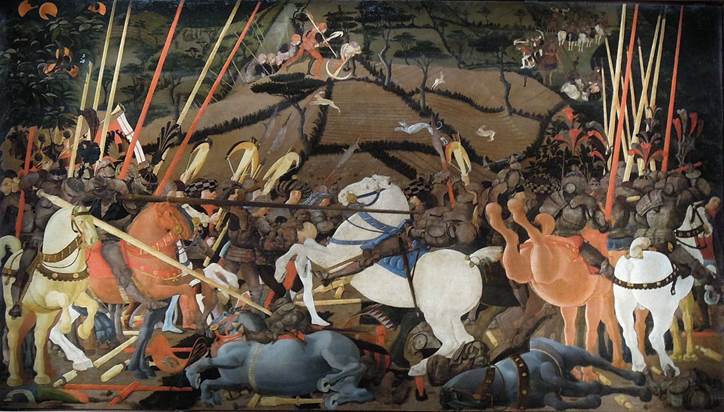
and torches held aloft –almost a distant precursor of the Battle of San Romano
by Uccello in the Uffizi), Christ before Caifa,
Flagellation of Christ (notice how classically Roman Pilate looks at
the far right), Ascent of Calvary (note the expression of
maternal anguish in the face of Mary, at the left, and Jesus’ expression as he
looks back over his shoulder towards her), Crucifixion, Mourning
over the Dead Christ, Resurrection, Ascension,
Pentecost.
The
Universal Judgment: This massive fresco that covers the rear wall
of the chapel is awesome –and a lot of fun.
In it, Jesus sits, enthroned, presiding over the judgment of humanity. Flanked by the twelve apostles, with the
saints and angels in attendance, there is a division into the blessed (on the
left side –and therefore to his right) and the damned (on the
right). Notice that things are much more
ordered and structured in heaven above and among the righteous on the left; a
swirling chaotic disorder characterizes the situation among the damned, with
Satan in the center (with one of the damned in his mouth, and one in another
orifice). (The arrangement is not
unrelated to that of Dante’s Inferno.) Things are actually much more interesting over
there, however: the fantasies of the
torments of Hell range from the horrifying (Nancy entertained the idea that
maybe in view of what we were looking at we should be careful…maybe even go to
confession!) to the wildly kinky (à la Hieronymus Bosch).
Gattamelata:
(1447-1453) Donatello’ equestrian
statue of Erasmo da Narni, a local military leader nicknamed Gattamelata, or
“the Cunning Cat,” stands in the piazza in front of Il Santo. This was the first equestrian statue of a
current hero in classical dress ever done since antiquity. It is a powerful, noble piece which certainly
succeeded in its attempt to honor the man it portrays
Basilica di Sant’Antonio -
Il Santo: This 13th century church is a
beautiful combination of Romanesque and Gothic styles, with a markedly Eastern
flavor. Its eight huge domes lend a
marvelous and unearthly quality to the interior.
High Altar of Il Santo: (The Basilica of
Sant’ Antonio) - 1446- 50 - This is perhaps the most complex of
Donatello’s projects. It contains seven
bronze statues of almost life size, four bronze reliefs, and one limestone
relief. (The origin altar itself was removed and
destroyed in the 16th century.
It is a source of considerable speculation what the actual form of the
altar was and what the arrangement of these sculptures on it was. While the experts do not agree on what the
original altar looked like, they are in agreement that it had little to do with
the current configuration.) Unfortunately, it is hard to get a close-up
view of these works, installed as they are on the high altar itself. This is especially true of the reliefs. If you go when no mass is being said and
there are not too many people around, you can usually persuade a guard into
turning on the extra lighting and allowing you access into the altar area
–which allows excellent viewing of the reliefs on the back of the altar, and
reasonable viewing of the sculptures (from the sides in front; but they will
not, of course, allow you to approach the front of the altar itself (which
means the reliefs on the front are almost impossible to view closely). (The comments in square brackets [] refer to the
sculpture’s position on the current altar.)
Bronze
Statues:
St.
Francis: [near left]
Has crucifix on his shoulder and holds a book.
St.
Anthony: [near right] Holds a book and a plant.
St.
Prosdocimus: [lower level, far
right] Patron saint of Padova, holds a
ewer.
St.
Daniel: [far right] holds a basin
St.
Guistina: [far left] holds a palm frond in her left
hand.
The
Virgin and Child Enthroned: [center]
Bronze
Reliefs: These four miracles of Saint Anthony are
miracles in an artistic sense, as well.
In them, Donatello uses symbolically the space he creates to emphasize
and enhance the stories he is portraying and the emotions those stories embody.
The
Speaking Babe: [back, right] Note the stage-like setting he creates for
the action.
The
Ass of
The
Irascible Son: [front, left] This is perhaps the most interesting of the
reliefs. Donatello, who, as we have
seen, was a master of linear perspective, here utilizes an obviously purposeful
combination of perfectly accurate and totally contrary perspectival devices to
create a shockingly disjointed space. It
has been suggested (particularly by
The
Heart of the Miser: [front,
right] Once dead, his heart is nowhere
to be found. Here note the architectural
depth of the space Donatello has created.
Limestone
relief: The Entombment of Christ: [back, center]
Here Donatello has presented us
with the power of the grief of those lowering Jesus into his tomb.
Aside from the
But soaking up the feel of
the place is the thing to do in
Some suggestions:
Take a vaporetto ride the
length of the Canal Grande (Vaporetto #1 is a good choice). Do it again another time, getting off here
and there. Walk over the three bridges
that cross the Canal Grande.
Do what the Access
guide notes as one of Marcella Hazan’s favorite things: go to Ciprianni’s (there’s a free, private launch
to get there [which is also fun], that leaves from Piazza S. Marco: just use the free phone to call if the launch
isn’t already there), and have a chocolate gelato in the bar next
to the pool. It’s heavenly! Use the opportunity to look around the hotel
and grounds, which are pretty spectacular.
Take the #52 Barata (52 with
a line through it –the one that goes to the left [counter clockwise] at
Zaccaria– through Il Arsenale (interesting), around Il Castello, past S.
Michele. and then to Murano (which is a nice place to walk around). On the way back, get off at Fondamenta Nuove
and take a walk through Il Cannaregio to Il Campo del Ghetto Nuovo –the
Jewish Ghetto (read Access on this one).
(There’s a restaurant near here that is supposed to be wonderful,
although we didn’t get to go: Osteria
al Bacco (Fondamenta delle Cappuccine, 3054; tel. 717493).
Walk around Il Castello, and
maybe take a look at Il Arsenale. Il Castello is a lovely residential
neighborhood. Don’t miss Via Garibaldi—it’s
a real neighborhood, and has a communal life apart from the normal tourist
hubbub of
For a rather delicious, very inexpensive, very informal meal, go to
Trattoria Alla Madonna, Calle della Madonna 594 (between Fondamenta del Vin and
Ruga Vecchia San Giovanni), in San Paolo, near the Rialto Bridge. The
food is surprisingly good--and VERY cheap. I just kept ordering
things—spaghetti in black sauce [squid ink]; risotto in the same; fried fresh
sardines; etc., etc.—and the seafood is fresh and wonderful. The house wine is drinkable...and the 15 euro
cabernet is actually delicious. It’s a funky place, where you end up
talking to the people sitting right next to you—and they are sitting right next to
you. It’s a bit hard to find, but,
coming off the
1) it is the third "street" west (to
the left off the bridge) of Ruga dei Orefici (which is the street
directly off the bridge);
2) these "streets" sometimes just look like
doorways from the Fondamenta (if you get to Calle Paradiso, you've gone two of
them too far); and,
3) there is no sign for it, nor does the numbering
seem correct; but when you get to a place on the right where there is light and
a lot of life and activity you can see inside, you’ve arrived at Trattoria alla
Madonna (the "street" itself seems like a dark, narrow, back alley in
which you won't expect to find anything—and won’t find anything else).
Eat dinner outside on the
terrace restaurant of the
Eat dinner at Al Covo,
it’s wonderful! Virtually all seafood
(usually one non-seafood alternative for each course), and no menu –they serve
a selection of the best things that were caught that day; and, boy, do they
pick and prepare it well! The place is
owned and run by a couple: the husband,
who is Italian (naturalmente!), is the chef, and the wife runs the dining room
–and she came from
Instead of spending a lot of
money on a gondola, ride one of the traghetti that go back and forth across the
Canal Grande at spots. Instead of LIT.
102.000 for a ride, these cost about 700 lire per person –same kind of boat, by
the way. There’s a convenient one that
leaves from the west end of Piazza San Marco (towards the Hotel Monaco) and
goes across to La Salute. While you may
not have any pressing need to go to La Salute, it is in Il Dorsoduro, which is
another very interesting place to walk around. It is also the cite of-
Collezione Peggy
Guggenheim: This place is unbelievable! It has some of the most beautiful, unusual
examples of the work of many very important modern artists that you will see anywhere. There’s a Rothko from just before he started
doing his characteristic thing: you can
imagine him looking at this painting and saying to himself, “I wonder what
would happen if I did a whole painting based on what I’ve done in this area of
this one…” There is a great Braque. Terrific examples of early Jackson Pollock,
Kandinsky, and DeKooning. An marvelous
pair of Mondrian paintings –one very early and one fully developed. Great sculpture: lots of Giacometti (and one very
unusual and beautiful torso in the garden), Henry Moore, and Calder. Good Picassos, a magnificent Duchamp, and a
great Schwitters. Lots of Max Ernst (who
was one of her husbands –apparently she also slept with a bunch of the other
artists whom she didn’t bother to marry). Endless treasures. An incredible, and for me, unexpected treat
(although
Take a vaporetto to Giudecca,
which is another nice place to walk around.
(Right there on the Canal Grande is another supposedly great place to
have a light dinner or dessert: Harry’s
Dolci [Fondamenta Sant’Eufemia, 773; tel. 5208337]; but we couldn’t get in
when we had time available to go.) Near
Harry’s Dolci, which is related to Harry’s Bar, by the way, is a nice
little grocery store where you can get panini made to order and eat them
sitting on benches (as opposed to eating at the tables in front of the store,
which costs more) looking at the Canal Grande.
A last idea: the lobby of the Danieli is a fabulous
place –especially the three story tall entrance atrium. Go in and check it out. They serve drinks (they serve a very nice 20
year old tawny port) and cappuccino –and they welcome cigar smokers!
ROMA
[The following are some
thoughts on some areas of Roma. They
have not yet been expanded to include my observations and other info; but they
might prove helpful as a starting place.}
One interesting area (1st three buildings are all across
the street from one another):
Temple of Vesta, Piazza Bocca della Verità (2nd Century BC –oldest standing marble
temple in Rome) cylindrical center, surrounded by 20 Corinthian columns. Actually misnamed: it is really dedicated to
Hercules the Conqueror.
Temple of Virile Fortune, Piazza Bocca della Verità (2nd Century
BC) Pre-Imperial Roman temple, heavily influenced
by Greek architecture
There's another interesting
Romanesque church nearby (but certainly not essential), San Giorgio in
Velabro on the via del Velabro, at via San Teodoro. This church has a gorgeous quattrocento altar
done by the Cosmati.
Remember with all the
churches, many are closed from ~12:30-3:30.
There is a great place to eat
lunch right in this neighborhood: San
Teodoro, on the via dei Fienili, it is lovely inside and in its outside eating
area, with great food. Moderately priced
and informal, at least for lunch
A second interesting
area:
Santo Stefano Rotondo (via di Sto. Stefano
Rotondo), 5th Century, centrally planned church consisting of three
concentric circles, separated by a double ring of granite columns. There is a 3rd Century Roman
temple to the Persian god Mithras which is currently being excavated beneath
the floor of the church. (Try to ignore
the gruesome 16th C. frescoes that cover the outer walls.)
Santi Quattro Coronati (“Four Crowned Saints,” via dei S. S. Quattro, between
via Sto. Stefano Rotundo and via dei
Querceti) This last remaining fortified abbey in Rome consists of a 4th
Century church, with a incredibly beautiful quattrocento chiostro, and a
trecento oratorio di San Silvestro (off to the right as you enter the church
itself; go up to the turntable in the wall where you will place a Euro in, and
an unseen nun will rotate it to get the money, and then re-rotate it to give
you a key to the oratory –they are taking no chances with having too much
contact with the secular world!) that has frescoes of the life of Constantine
frescoes).
A third grouping:
The Pantheon (Piazza della Rotunda), Built by Hadrian in 125 AD
(and dedicated to Marco Agrippa, the
son-in-law of Augustus), this may be the most spectacular building in
Palazzo Doria Pamphili (via del Corso, 304, between Piazza Venezia and via
Lata) is VERY interesting
(although hardly 'essential')
–a window into how extremely rich Roman
nobility have lived over the years. One of
that family became Pope Innocent X. Best
if you get there not long after they open at 10 AM, so as to get a ticket for a
tour of the private quarters as well as the public rooms.
The only Baroque church I'd
suggest (not too over the top, and actually quite beautiful) is Sant'Ivo
alla Sapienza, by Boromini, on Corso di Rinascemente (at via dei
Straderar). Built in 1660, it is a
marvelous, centrally-planned building of pure white stone. The only ‘color’ is the steel-gray of the
floor tiles which alternate with white ones.
An outstanding taste of
ancient
Foro di Traiano (Trajan’s Forum), largest and most ambitious of the
Imperial For a to have been built (2nd century AD), there are now
only traces remaining.
Foro Romano (The Roman Forum) –a truly extraordinary place. Get a guide an revel in the remains of
ancient
Arch of
Our favorite area was Trastevere,
where we spent half a day simply wandering and exploring. It is full of tiny, winding streets, lined
with shop of various artisans. We loved Santa
Maria in Trastevere, and especially its wonderful mosaics. (We also loved the cafe right next to the
church, where we had some of
the best sprumante (fresh
juice) I've ever tasted.)
We also took a lovely walks
through the Villa Borghese, and virtually in
every direction from the
Piazza del Popolo to the Spanish Steps to the
Piazza Navona il Campidoglio.
Some restaurant suggestions:
We had a delicious and fun
meal at Pierluigi, Piazza dei Ricci, 144 at via Monserato (not far from
the bridge, Ponte Mazzini, on the main side of the river). Moderately priced and informal, they serve
wonderful seafood, inexpensive wine, and a delicious beef stracciata. Tel. 6861302
We had a wonderful and
romantic meal at Romolo, via Porta Settemiana, 8, at the foot of via
Garibaldi. The garden is particularly
beautiful, if the weather permits.
Although the food is not gourmet, it is quite enjoyable. Tel. 5818284
We also enjoyed our espresso
at Rosati, one of Rome’s grand caffes (Piazza del Popolo, 5/A) and extraordinary gelati at Giolitti
(via Uffici del Vicario, 40); and, no matter how many people know about and how
touristy a thing it is to do, the tartufo at Tre Scalini in the Piazza
Navona is an absolute must.
There is a small Neapolitan
restaurant near S. M. della Pace, Tratoria and Pizzeria della Pace,
which is very cheap and good. (Try
especially their Bufalo mozzarella and tomatoes, and their fried Neapolitan
pizza.
La Cesarina. Via Piemonte, 109 (Via
Anacleto Bleve. (through a
virtually unmarked [except for a small brass plaque] big dark wood door) on via
Teatro Valle. This lovely, stylish wine
bar is a prefect place for lunch—or dinner, if you don’t mind the fact that
they only serve cold food. Order a plate
of involuti (rolled hors d’oeuvres), or perhaps a plate of salamis; but don’t
fail to order their wonderful cheese plate.
Ask them to suggest a marvelous, inexpensive wine. This small, family-run establishment it well
worth a stop.
And, while on the subjects of
wine bars, two that come extremely highly recommended (although not tried by us
due to the fact that they are somewhat out of the way in San Lorenze) ones are Tram
Tram (near the tram, naturally—Via dei Reti, 44/46) and Uno e Bino (Via degli Equi, 58) .
Milano is mostly a modern,
industrial city, and, as such, is a completely different story from all the
others. There’s no art there I am
particularly interested in –if you exclude hearing great opera at La Scala; and
yet, it’s an interesting place. Here’s a
walk that you can do in 2-3 hours (or much more, depending on how much time you
want to spend in the stores) that provides a good taste of a major piece of
what’s there:
Start
at Il Duomo (take the Metro there from just about anywhere) and walk through
the Piazza to the left (facing the front of the church) to the Galleria
Vittorio Emanuelle II –a wonderful, covered space with stores and cafes (the
first mall?). Continue straight, through
the Galleria, diagonally across the Piazza La Scala (with the deceptive
uninteresting exterior of that august place to your left) to the Via A.
Manzoni, slightly off to your right.
Follow that to the Via Montenapoleone, onto which you take a right. (NB:
all of these segments are quite short.)
This
brings you to Il Qudrilatero, formed by Via Sant’Andrea, Via della Spiga, Via
Borgospesso, and the street you’re on, Via Montenapoleone –which is the area in
which are found most of the world’s biggest names in clothing and accessory
design who have made Milano the fashion capital of the world. You can spend as much time here as your
interest and your resistance (and/or fabulous wealth) allow. (At none of these stores will you see a
single price tag…does this suggest anything?)
For the brief version, I’d suggest continuing down Via Montenapoleone to
Via Sant’Andrea, on which you go left one block to Via della Spiga, on which
you go right one block to Corso Venezia.
A
left on Corso Venezia takes you into Porta Venezia, and the most exclusive
residential district of Milano. Take a
quick right
onto
Via San Damiano, and then the next left onto Via Mozart. Look around.
Here begins a neighborhood that is breath-takingly beautiful and wealthy
(although apparently the best stuff is in enclosed courtyards within the center
of many of these buildings). Go one
block on Via Mozart, past Via
Serbelloni, to the next left (I don’t know the name of this little street, but
it’s only one block long) and take it until it dead ends on Via
Cappuccini. Directly ahead of you,
across the street and a little to the left, is a black metal fence with a
garden behind it –look in: there are
flamingos, peacocks, and other rare birds.
It’s the private garden of a private palazzo of a very wealthy
industrialist and his wife (who, in their 80s, live there alone –except for
throngs of servants)…and it is a trip!
Take a left on the Via Cappuccini to the Via Serbelloni; take a short
right, and then right again onto Corso Venezia.
Follow this to the Civico Museo di Storia Naturale (the Natural History
Museum).
Take
a left at the Museum and enter the Giardini Pubblici (the first of its kind in
I was told the Casanova
Grill (in the Palace Hotel, directly across the Piazza from Il Principe
di Savoia) is the best restaurant in Milano.
It is beautiful, formal, very elegant, and we loved it. We had (after a glass of champagne and an
amuse gueule of some sort of prosciutto and herb thing): a shared antipasto of foie gras with rose
pepper corns and herbs; for i primi, spaghetti with vongole and asparagi for
me, and a pasta with a sauce of tomato and crushed yellow peppers for Nancy;
for i secondi, costelletto di agnello (simply prepared, but unbelievably good)
for me, and a filetto di manza (fillet mignon) for Nancy; with all of the above
we drank a Sassacaia ’93 –which was both wonderful and relatively reasonable;
then a shared course of assorted rare Piemontese cheeses (too unusual for any
name recognition, but exquisite) with a glass of port; and finished off with a
tiramisu and espresso and cappuccino.
Expensive, but heavenly!
Reservations necessary; tel. 29000803.
A less rarified, but quite
delicious and sophisticated alternative is Da Giacomo. The specialties here are fish and shell fish
(although there are other wonderful alternatives): the linguini alla Giacomo is
a veritable biology lesson in crustaceans, and incredibly delicious. There is a very interesting and well-priced
wine list. All the food was exceptional, and the dessert cart was not to be
believed! Stylish dress (jacket and tie), and reservations essential. Tel. 76023313. Via Sottocorno, 6, at via
Cellini.